
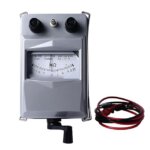

Description:
Insulation Resistance Tester Meter ZC11D-10 is required in use away from magnetic fields placed horizontally. 2500V resistance megger megohmmeter is as insulating Determination may be the ends of the analytes are connected respectively on the two terminals of the “ground” and “line” at rated speed rotating cranks, the resistance value can be measured. This ZC11D10 insulation ohmmeter is applicable to measure the insulation resistance of motors, cables, transformers, electronic components, home appliances and other electric devices, as well as the insulation measurement of resistance wire’s strain gauge.
Features Of Insulation Megohm Tester Megger Megohmmeter ZC11D10:
Use of conditions: temperature -25 ~ + 40 relative humidity less than 80%.
The nominal speed of the cranks: 150r / min.
Length of the arc of the scale: approximately 80mm.
Tilt effect: when the instrument from the horizontal position to any direction inclined to 5, The instrument allows the amount of changes to 50% of the level index.
The effects of the external magnetic field: When the external magnetic field reaches 100% kA / m, the instrument allows to change a quantity of the level index.
The outer magnetic field effect: when the external magnetic field to 0.4kA / m, the instrument allows to change an amount of 100% of the level index.
Specifications Of High-Quality Insulation Resistance Meter ZC11D 10:
Rated voltage (V): 2500
Rated voltage tolerance: 10%
Measuring range of M Europe: 0-2500
Precision: 20
M Europe: 30
Relative Humidity: ≤80%RH
Operating Environment: -25ºC~40ºC
Working Position: horizontal
Rated Rocking Speed: 150rpm
Gross Weight: ≤11kg
Dimensions: 215×135×130mm
Weight: approx. 1.5kg
Operation and Use
-
Placement: Use the instrument away from magnetic fields and ensure it is placed horizontally.
-
Connecting the Tester: Connect the ends of the analytes to the “ground” and “line” terminals. When rotated at the nominal speed, the device will measure the resistance value. Ensure that the “line” terminal makes good contact with the “ground” column during communication tests.
-
Core Cable Insulation Testing: To measure insulation of the core cable housing, connect both ends respectively to the “ground” and “line” terminals. Also, check the insulation layer between the core and the housing, including the “protection ring” of the cable.
-
Storage Conditions: When not in use, store the insulation tester in a stationary cabinet. Avoid extreme temperatures, moisture, dirt, and corrosive environments (such as acids or alkalis).
-
Vibration and Handling: Avoid intense or long-term vibration to prevent damage to the head shaft and gems, which could affect scale readings.
-
Cable Connections: Connect the three cables between the terminals and the measured object separately. Do not let them touch the ground, as poor connections may affect readings.
-
Safety Precautions: Always fully discharge the analyte before and after measurement to protect both equipment and personnel. Also, do not use the tester near lightning or high-voltage equipment unless you have de-energized it and removed any residual charge.
-
Operation of Handle: Rotate the handle gradually and slowly. Do not continue if the pointer shakes vigorously at zero, as this could damage the coil.
Package Includes:
1 x 2500V Insulation Resistance Tester Meter ZC11D-10





Reviews
There are no reviews yet.