
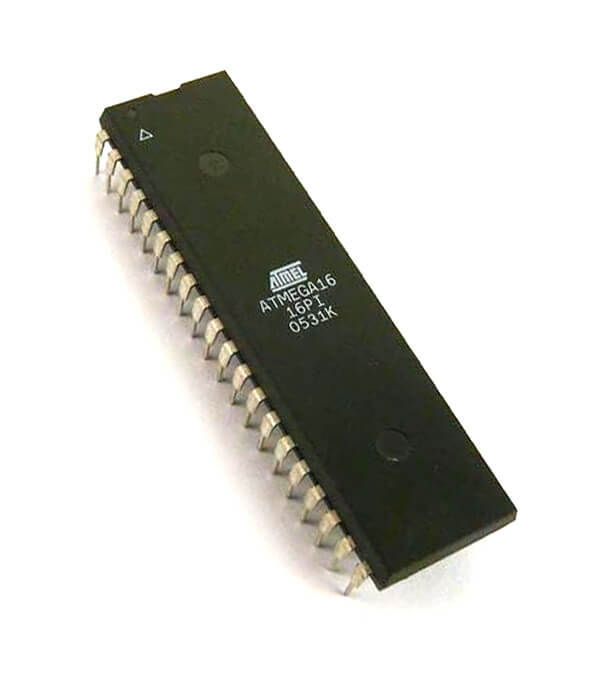
Description:
he ATmega16 is a low-power, 8-bit microcontroller from the Atmel AVR family, based on an enhanced Reduced Instruction Set Computing (RISC) architecture. It is a versatile and popular choice for a wide range of embedded systems due to its robust features, low power consumption, and high performance.
Key features and specifications:
- CPU: The ATmega16’s 8-bit AVR RISC processor can execute up to 16 million instructions per second (MIPS) at its maximum clock speed of 16 MHz. It has 32 general-purpose working registers that allow for fast, single-cycle access for efficient code execution.
- Memory: It is equipped with multiple types of memory:
- Flash: 16 KB of in-system self-programmable Flash memory for storing the program code, with an endurance of 10,000 write/erase cycles.
- SRAM: 1 KB of internal Static RAM for temporary data storage.
- EEPROM: 512 bytes of Electrically Erasable Programmable Read-Only Memory for long-term data storage, with an endurance of 100,000 write/erase cycles.
- I/O and interfaces:
- I/O lines: 32 programmable input/output (I/O) lines, organized into four 8-bit ports (PORTA, PORTB, PORTC, and PORTD).
- Analog-to-Digital Converter (ADC): An 8-channel, 10-bit ADC for converting analog signals from sensors and other external devices into a digital format the microcontroller can process.
- Timers/Counters: Two 8-bit timers/counters and one 16-bit timer/counter, which can be used for timing, counting events, and generating PWM signals.
- PWM Channels: Four channels for Pulse Width Modulation, used for controlling motor speed, brightness of LEDs, and other analog outputs.
- Serial Communication: Supports standard communication protocols including Universal Synchronous/Asynchronous Receiver/Transmitter (USART), Serial Peripheral Interface (SPI), and a byte-oriented Two-wire Serial Interface (TWI, or I2C).
- JTAG Interface: An interface for boundary-scan testing and on-chip debugging.
- Power management: The ATmega16 features multiple software-selectable sleep modes (Idle, ADC Noise Reduction, Power-save, Power-down, Standby, and Extended Standby) to minimize power consumption.
- Watchdog timer: A programmable watchdog timer with its own on-chip oscillator can reset the microcontroller in case of a program malfunction.
Common applications:
The ATmega16’s versatility and cost-effectiveness make it a popular choice for a wide range of applications, especially in embedded systems. Some common uses include:
- Robotics and automation
- Home automation systems and appliances
- Motor control systems
- Temperature and pressure control devices
- Analog signal measurement and manipulation
- Industrial automation
- Security systems










Reviews
There are no reviews yet.