
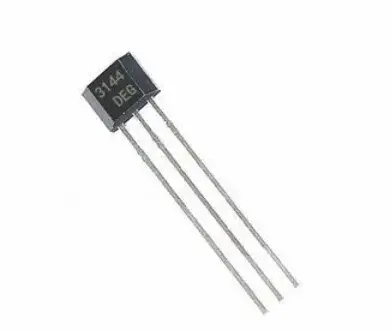
Description:
The device includes an on-chip Hall voltage generator for magnetic sensing, a comparator that amplifies the Hall voltage, and a Schmitt trigger to provide switching hysteresis for noise rejection, and open-collector output.
The internal bandgap regulator provides a temperature-compensated supply voltage for the circuits and supports a wide operating supply range.
When the magnetic flux density rises above the threshold Bop, the sensor drives the DO output low (on). The output remains in this state until the flux density reverses and falls below Brp, at which point the sensor drives DO high (off).
Key features:
- Digital output: Unlike analog Hall sensors, the A3144E has two states:
ONandOFF. When a sufficiently strong magnetic field is detected, the output goes low (ON). When the magnetic field is removed, the output returns to a high state (OFF). A pull-up resistor is needed to keep the output high when no magnetic field is present. - Built-in hysteresis: A Schmitt trigger is included to prevent the output from oscillating, or “chattering,” when the magnetic field is at the switching threshold. This provides clean, fast, and reliable switching.
- Unipolar sensing: The sensor is designed to be triggered by a single magnetic pole (typically the south pole). Moving a north pole toward the sensor will not trigger it.
- Open-collector output: The output stage is an open-collector NPN transistor, which can sink a maximum output current of 50mA. This allows it to directly drive loads like LEDs or the base of a larger transistor.
- Wide operating voltage: The A3144E can operate on a DC supply voltage between 4.5V and 24V.
- Built-in protection: The device includes a reverse polarity protection circuit.
How it works:
The A3144E uses the fundamental Hall effect principle.
- A current is passed through a thin sheet of semiconductor material inside the sensor.
- When the south pole of a magnet is brought close to the branded face of the sensor, its magnetic field is perpendicular to the current flow.
- This magnetic force deflects the moving charge carriers (electrons) to one side of the semiconductor sheet, creating a small voltage difference across the material. This is the Hall voltage.
- The Hall voltage is amplified by a small-signal amplifier and fed into a Schmitt trigger circuit.
- When the magnetic flux density crosses a specific threshold, the output of the Schmitt trigger flips, turning the internal open-collector transistor
ONand causing the output pin to switch to a low state. - When the magnetic field is removed and falls below a lower release threshold, the output switches
OFFand the output pin returns to a high state.
Common applications:
Due to its robust design and non-contact operation, the A3144E is used in many applications:
- Proximity sensing: Detecting the presence of an object attached to a magnet.
- Position sensing: Measuring the position of a moving part in a machine, such as detecting door and window openings.
- Speed and RPM detection: Counting the revolutions per minute of a motor or shaft by using a rotating magnet or a magnetic disc.
- Magnetic switches: Creating non-contact switches for alarms or automated equipment.
- Brushless DC motor control: Used for commutation to determine rotor position.






Reviews
There are no reviews yet.