
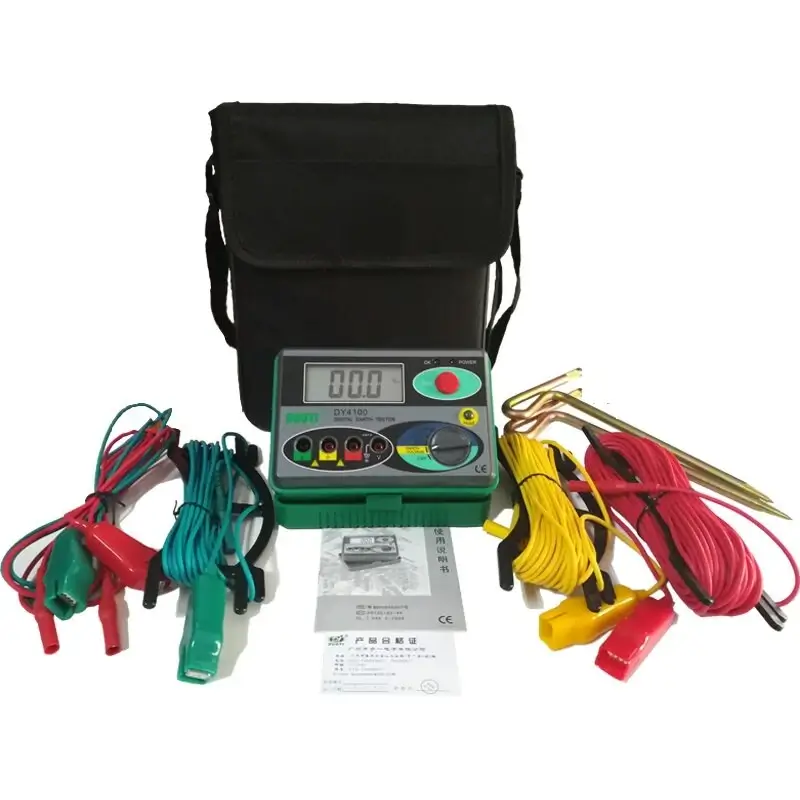
Description:
The DY4100 Digital Earth Tester, developed by DUOYI, is a compact and durable instrument used for measuring earth ground resistance and earth voltage. Its design improvements over traditional testers make it more practical for professional outdoor use.
Features:
-
- Measurement range: Measures earth resistance from 0.01
Ωcap omega
Ω
to 2000
Ωcap omegaΩ
with a 0.01
Ωcap omegaΩ
resolution.
- Earth voltage measurement: Can test earth voltage in a range of 0 to 30V AC.
- Three-wire testing: Capable of performing precise three-wire measurements, which is the standard for most applications.
- Safety and durability: Features a dust and moisture-proof structure, and is designed with overload protection for both voltage and resistance measurement.
- Convenient display: Equipped with a large LCD screen for clear readings, a data hold function to freeze the displayed value, and a low battery warning.
- Portable kit: Comes complete with test leads, auxiliary earth bars, and a heavy-duty carrying case.
- Measurement range: Measures earth resistance from 0.01

Specifications:
- Inspect the site. Ensure the ground area is moist. If the ground is dry or sandy, pour water around the area where you will place the auxiliary earth bars to improve conductivity.
- Turn on the tester. Rotate the function selector dial from “OFF” to the desired resistance range (20
Ωcap omega
Ω
, 200
Ωcap omegaΩ
, or 2000
Ωcap omegaΩ
). Always start with the highest range if the resistance is unknown.
- Check earth voltage.
First, switch the dial to the “Earth Voltage” (EV) setting before measuring resistance. Then, connect the red and green test leads to the V and E terminals, respectively. Next, check the reading; it should be below 10V. However, if the value is higher, turn off the power supply to the electrical equipment being tested. In addition, verify that all connections are secure to prevent fluctuations. As a result, you will avoid inaccurate results and ensure safer, more reliable measurements.. - Set up the probes.
-
- E (Earth) terminal: Connect the green test lead to the main grounding electrode being tested.
- P (Potential) terminal: Drive the yellow auxiliary earth bar (P1) into the ground at a distance of about 5–10 meters from the main electrode. Connect the yellow test lead to the P terminal.
- C (Current) terminal: Drive the red auxiliary earth bar (C1) into the ground at the same distance away from the P1 bar. Connect the red test lead to the C terminal.
-
- Measure resistance.
- After setup, press the “Test” button, and the meter will inject a current into the ground; then, it will display the resistance value. If the reading is “1”, the resistance is out of range; therefore, switch to a higher range and test again. However, if the reading appears unsteady, repeat the test with the auxiliary earth bars placed at different intervals. In addition, ensure the connections are firm to achieve reliable results. As a result, you can confirm consistent and accurate measurements.






Reviews
There are no reviews yet.